
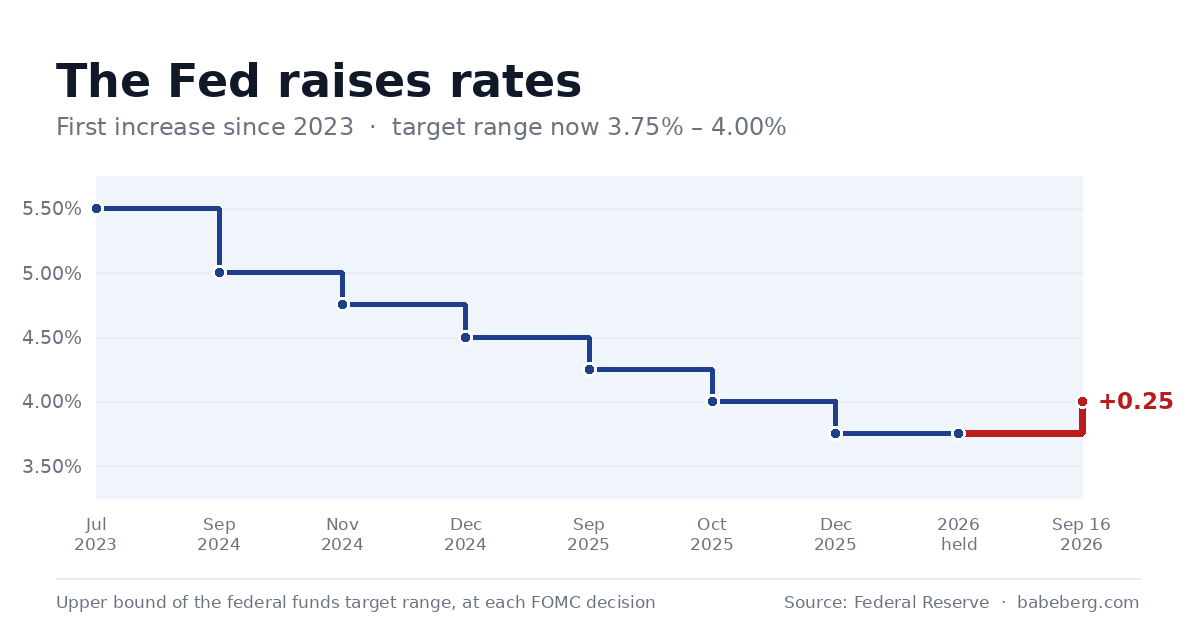
The Federal Reserve raised its benchmark interest rate on Wednesday, the first increase in three years, lifting the target range for the federal funds rate by a quarter of a percentage point to 3.75% to 4.00%.
The vote was unanimous. It is the first rate rise since 2023, and it reverses one of the seven cuts the Fed made between September 2024 and December 2025.
The Committee was blunt about why. "Inflation remains elevated," the statement said. "Today's policy action will support a timelier return to the Committee's 2 percent goal. The Committee will deliver price stability."
What the Fed actually said
The statement described an economy that is not struggling. Activity is "expanding at a solid pace," domestic spending has been "resilient," productivity growth is "strong" and capital investment "robust." Job gains have kept pace with the workforce and the unemployment rate has changed little.
That combination is the whole argument for the move. When an economy is weak, raising rates risks tipping it over. When it is growing steadily and inflation is still above target, the case for waiting gets harder to make.
At the press conference, Chair Kevin Warsh — in his fourth meeting since taking office in May — said the Committee had decided to "buy time" seven weeks earlier, and that the summer had not delivered what it was waiting for.
"This summer's inflation readings do not tell me that underlying trends have meaningfully improved."
Warsh drew a careful distinction about what the Fed can and cannot do about prices at the pump and in the supermarket:
"We cannot affect any individual price. But what we can do and will do is ensure that any change in relative prices don't broaden out."
That sentence is the key to the decision, and it is worth unpacking.
The 101: what raising interest rates actually does
The Fed does not set the interest rate on your mortgage, your car loan or your savings account. It sets a target range for the federal funds rate — what banks charge each other for overnight loans. Everything else is downstream.
When that overnight rate goes up, the cost of money goes up throughout the system, in roughly this order:
| What moves | Roughly when | Who feels it |
|---|---|---|
| Bank-to-bank lending | Immediately | Banks |
| Credit cards, home equity lines | Days to weeks | Households carrying balances |
| Car loans, business borrowing | Weeks to months | Buyers and firms |
| Savings accounts, CDs, money markets | Weeks to months | Savers |
| Mortgages | Indirectly, via bond markets | Buyers and refinancers |
Mortgages are the one people expect to track the Fed exactly, and they don't. A 30-year mortgage is priced off long-term bond yields, which move on where investors think rates and inflation are heading over years, not on what the Fed did this afternoon. A rate rise that convinces markets inflation will be brought to heel can leave long mortgage rates flat, or even pull them down.
How that is supposed to bring prices down
Raising rates is a demand tool. It works by making borrowing more expensive and saving more rewarding, which is intended to:
- Slow spending that is financed by credit. A more expensive car loan means some people buy a cheaper car, or keep the one they have.
- Slow business investment and hiring. Projects that made sense at 3.5% may not at 4%, so some are delayed.
- Reward saving. Money parked in a deposit account earns more, so some of it stays parked rather than being spent.
- Firm up the dollar. Higher returns attract foreign money, and a stronger dollar makes imports cheaper, which pulls directly on the prices of imported goods.
Less demand chasing the same goods means sellers have less room to raise prices. That is the whole mechanism. The Fed cannot produce more oil, build more houses or unsnarl a supply chain — it can only cool the demand side of the equation until prices stop climbing.
Why the Fed cares so much about "broadening out"
This is the part of Warsh's comment that matters most, and it explains why the Fed is raising rates into an economy that looks healthy.
When energy prices rise, that shows up in inflation immediately. On its own, that is a relative price change — energy costs more compared with everything else — and central bankers usually look through it, because it tends to reverse.
The danger is the second round. Expensive fuel raises the cost of shipping, which raises the cost of goods. Workers who watch their bills climb ask for larger raises. Firms granting those raises put up prices to cover them. At that point the increase has stopped being about energy and has spread through the whole economy — and crucially, people begin to expect higher inflation and act accordingly, which makes it self-fulfilling.
Economists call the thing the Fed is protecting anchored inflation expectations. Once they come unanchored, the historical record says getting them back costs far more — in unemployment and lost output — than acting early. That is the trade the Fed believes it is making: a small amount of restraint now against a much larger bill later.
What it means for the economy
For borrowers, anything on a variable rate gets more expensive fairly quickly. Credit card APRs and home equity lines typically reprice within a billing cycle or two. A quarter point on a $10,000 balance is about $25 a year — small in isolation, and the reason the Fed moves in quarter-point steps rather than lurches.
For savers, the first good news in a while after seven consecutive cuts. Deposit rates follow the funds rate up, though banks are historically quicker to pass on rises to borrowers than to savers.
For the housing market, the direct effect is muted for the reason above. Watch the 10-year Treasury yield rather than the Fed's announcement.
For jobs, this is where the cost sits. Cooling demand is not a precision instrument: the same slowdown that takes the heat out of prices also slows hiring. The Fed's judgment is that with job gains keeping pace with the workforce and unemployment steady, the labor market can absorb a quarter point.
For markets, the reaction was mild — which is itself informative. The S&P 500 was up about 0.4% and the Nasdaq about 0.8% in the session, with the Dow little changed. Markets had largely priced this in; a rise that surprises nobody does not move much.
What happens next
The updated projections are the real news for anyone trying to read the path ahead: 16 of the 18 policymakers expect at least one more increase before the end of the year. That is close to unanimous, and it signals that Wednesday's move was not intended as a one-off adjustment but as the start of a short tightening sequence.
Three things will decide whether that happens: whether energy prices keep feeding through, whether wage growth starts tracking them, and whether the labor market stays as steady as it has been.
The Fed has told us what it will do if the answers go the wrong way. It said it in the statement, in six words: "The Committee will deliver price stability."
Sources: Federal Reserve FOMC statement, September 16, 2026 · CNBC · CNN Business

0 Comments
No comments yet. Be the first!
Leave a Comment