
Author: Stan Switaj
Updated November 2, 2026: Anthropic has filed an amended S-1 with its third-quarter results. The full update is in the section that follows. It now includes our guess of the price range, $85 to $95 a share, worked out from the S-1; Anthropic has not announced one.
Anthropic, the company behind the AI assistant Claude, made its IPO paperwork public on Monday, October 26, 2026. It plans to list its Class A shares on the Nasdaq Global Select Market under the ticker ANT, with Goldman Sachs and Morgan Stanley leading the offering.
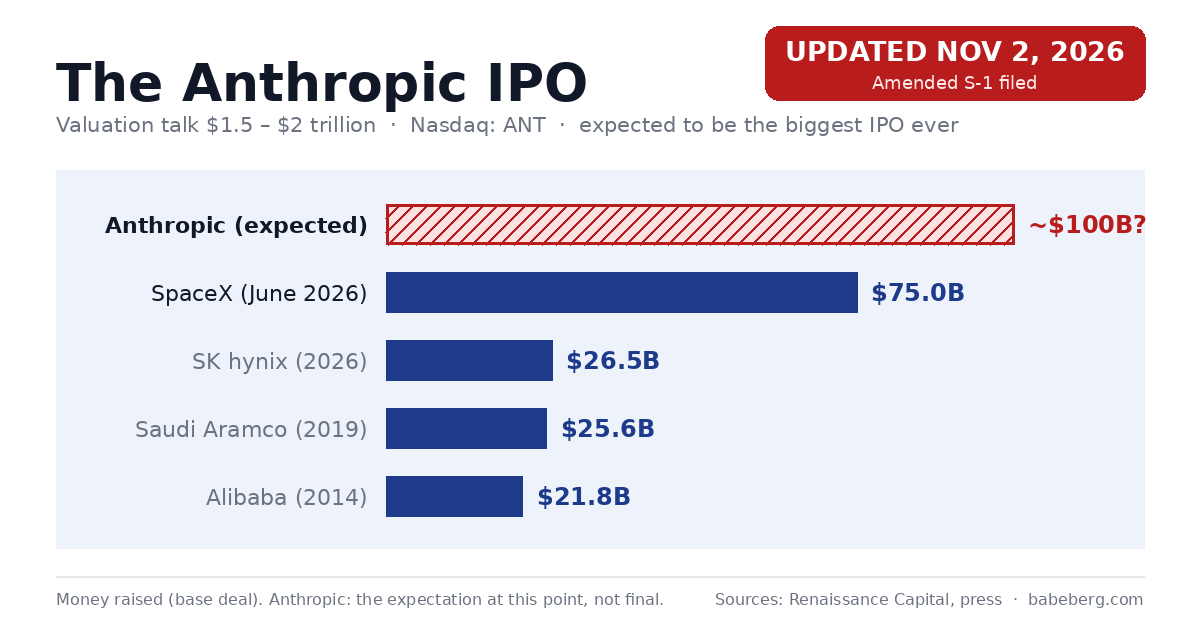
Investors are talking about a valuation of $1.5 trillion to $2 trillion. Reports say the offering could raise as much as $100 billion, which would make it the biggest IPO in history, ahead of SpaceX's record listing in June.
A caveat: that is the expectation at this point, not a final number. The filing leaves the share price range and the number of shares blank, so both the valuation and the amount raised will only be known once the deal is priced. Analysts expect it as early as November.
Update, November 2, 2026: the amended S-1
On Monday, November 2, 2026, Anthropic filed Amendment No. 1 to its Form S-1 with the Securities and Exchange Commission (an "S-1/A"). It replaces the October 26 filing as the company's current prospectus.
What an amended S-1 is. A company rarely gets its IPO paperwork right in one go. After the first public filing, the SEC sends comments, the company's latest quarter closes, and the bankers sound out investors, so the company files amendments, each one a complete new version of the prospectus. The amendments usually come in a set order:
- The first amendments add the latest quarterly results and answer the SEC's questions. This filing is one of those.
- A later amendment adds the price range and the number of shares. That one marks the start of the roadshow, when the company pitches the shares to investors.
- The final prospectus is filed after the price is set, the night before trading begins.
This amendment fills in the third quarter of 2026 (July to September), which the October filing left blank. The price range and the number of shares are still blank, so the valuation and the amount raised are still not known.
The new third-quarter numbers
| Item | Third quarter 2026 | What it means |
|---|---|---|
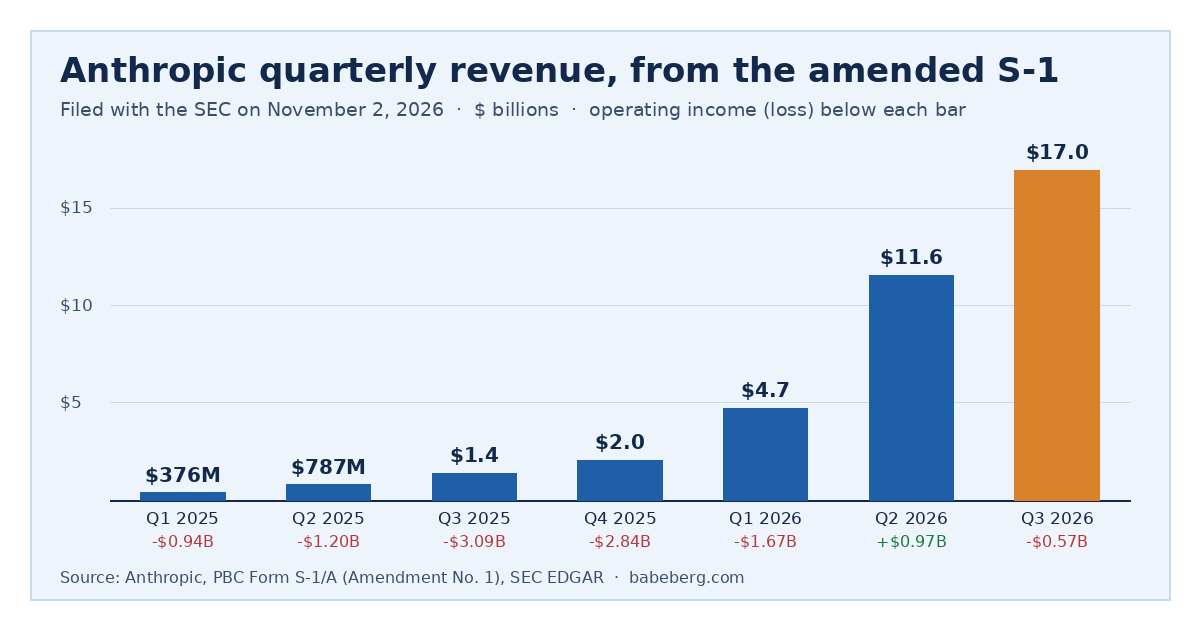
| Revenue | $17.0 billion (exactly $16.956 billion) | Up from $11.6 billion in the second quarter, and 1,127% higher than a year earlier ($1.4 billion) |
| Operating result | Loss of $567 million | A step back from the $974 million profit in the second quarter (explained below) |
| Adjusted operating income | $2.5 billion, a 15% margin | Anthropic's own measure, which leaves out stock pay and other non-cash items; it was $2.2 billion (19%) in the second quarter |
| Net loss | $23.3 billion | About $21.9 billion of it is a non-cash accounting charge (explained below) |
| Computing costs | $9.9 billion | Up from $5.6 billion in the second quarter |
Why the quarter swung back to an operating loss. The filing gives two main reasons. First, demand ran ahead of Anthropic's long-term computing contracts, so it bought $5.0 billion of short-term computing capacity, which costs significantly more than its contracted capacity. Second, it booked a $2.0 billion non-cash charge for a program that matches employees' charitable donations. Price cuts that came with new Claude models and customer discounts also took about $600 million off the quarter's revenue.
Why the net loss is so much bigger than the operating loss. Before the IPO, investors put money into Anthropic through convertible notes and similar instruments that turn into shares later. Accounting rules make the company revalue them every quarter, and as Anthropic's own valuation rises, they count as a bigger liability, which shows up as a loss. That charge was about $21.9 billion in the third quarter. It is a paper loss, not cash going out the door, and it stops once those instruments convert into shares at the IPO.
First nine months of 2026
| Item | Nine months to September 30, 2026 | A year earlier |
|---|---|---|
| Revenue | $33.2 billion (up 1,206%) | $2.5 billion |
| Operating loss | $1.3 billion | $5.2 billion |
| Adjusted operating income | $4.1 billion | Loss of $3.1 billion |
| Net loss | $104.0 billion, mostly non-cash | $25.1 billion |
| Cash from operations | $6.6 billion coming in | $2.0 billion going out |
The last line matters. Despite the headline losses, the business brought in more cash than it spent on operations in 2026. Its spending on chips and data centers shows up separately, as investment.
Money in the bank, and the bills to come
- Liquidity: $146.6 billion as of September 30, made up of $95.6 billion in cash, $36.3 billion in short-term investments, and $14.8 billion of unused credit. That is before any money from the IPO. Anthropic has raised $141.1 billion since it was founded, and its debt stands at $6.2 billion.
- Commitments: Anthropic has agreed to spend about $895.4 billion in the coming years, almost all of it on computing power and data centers. About $69.8 billion falls due in the next 12 months, and $447.5 billion before the end of 2030. The rest stretches out to 2045.
- The biggest suppliers named: about $161.2 billion of equipment leases tied to Broadcom, at least $121.3 billion with Google (up from $114.5 billion in the October filing), up to $120.5 billion with SpaceX's AI unit, and at least $110.0 billion with Amazon.
Customers
| Customers spending, over the past 12 months | As of September 30, 2026 |
|---|---|
| $100,000 or more | More than 11,900 |
| $1 million or more | More than 1,900 |
| $10 million or more | About 250 |
Those customers above $100,000 account for about 74% of revenue. The other 26% comes from about 40 million smaller customers. Anthropic reports net revenue retention of about 900%: on average, existing customers spent about nine times as much as a year earlier. In the first nine months, 79% of revenue came from usage-based fees (mostly businesses paying for what they use through the API) and 21% from subscriptions.
What else is new in the amendment
- Shares for ordinary investors. Part of the offering will be sold to retail investors through Charles Schwab, Fidelity, Robinhood, SoFi, Trade-PMR and E*TRADE from Morgan Stanley, at the same IPO price the big institutions pay. The October filing did not have this section.
- A new warning about the pace of AI progress. Anthropic says its internal estimates and its expectations about future models indicate it "may imminently meet" its own safety policy's definition of "dramatically accelerated progress attributable to AI", meaning AI speeding up AI research itself. It stresses that it has "not designated any of our current models as exceeding this threshold." It says it may keep taking precautions, including delaying the release of models and limiting their initial availability, as it did with its Mythos model.
- A new subscription plan is named. The filing now refers to the Claude Pro, Max, and Ultra plans. Ultra does not appear in the October version.
- Revenue from rule-breakers. Anthropic still estimates that 5% to 7% of its revenue in the first nine months came from customers later found to be breaking its usage policy or commercial terms. It says that share should fall now that enforcement was stepped up in August and September, which could slow revenue growth.
What is still blank, and what comes next
Still missing from the filing: the price range, the number of shares, the amount to be raised and Anthropic's latest annualized run rate. The next amendment should fill in the first three.
The expectation at this point, from press reports and not from the filing:
- Valuation: Bloomberg reports investors discussing $1.4 trillion to $1.5 trillion, at the low end of the earlier $1.5 trillion to $2 trillion talk.
- Roadshow: possibly starting the week of November 9.
- Listing: before the end of November, on Nasdaq as ANT.
None of these dates or figures is confirmed until Anthropic files its price range and then prices the deal.
Babeberg's price range guess: $85 to $95 a share
This is a guess, not a figure from Anthropic. The amended S-1 does not give a price range. The estimate below is our own, worked out from numbers in the S-1 itself plus the valuation investors are reported to be discussing.
How we arrived at it:
| Step | Figure | Where it comes from |
|---|---|---|
| Price investors paid in the Series H round (May to June 2026) | $589.01 a preferred share | The S-1 |
| 10-for-1 stock split on September 17, 2026 | divide by 10 | The S-1 |
| Series H price in today's shares | about $58.90 a share | $589.01 ÷ 10 |
| Valuation at that round | $965 billion | Press reports of the round |
| Implied total share count | about 16.4 billion shares | $965 billion ÷ $58.90 |
| Valuation now being discussed | $1.4 trillion to $1.5 trillion | Bloomberg |
| Implied price | about $85 to $92 a share | $1.4 trillion to $1.5 trillion ÷ 16.4 billion |
Rounding to the kind of $10-wide band companies usually announce gives $85 to $95 a share.
Why we think it is a reasonable guess:
- It starts from a real price. Series H was the most recent time large investors paid cash for Anthropic shares, about $45.7 billion of it, and the S-1 states that price exactly. It is the best anchor available for what a share is worth.
- The split is accounted for. Without dividing by 10, the Series H price would look like $589 a share; the September 17 split makes it $58.90 in the shares that will actually trade.
- The share count is implied by the market, not invented. Dividing the round's valuation by its per-share price gives the number of shares that valuation was based on, so the same share count can be used to turn the new valuation talk into a price per share.
- The valuation used is the current one. Bloomberg's latest reporting puts investor talk at $1.4 trillion to $1.5 trillion, which is where the $85 to $92 comes from; the band is widened to $95 in the usual way.
- It rises from Series H by a believable amount. $85 to $95 is about 45% to 60% above the Series H price five months earlier, in line with how fast Anthropic's revenue has grown since (third-quarter revenue of $17.0 billion).
What could make it wrong:
- More shares. Shares added at the IPO (converting notes, stock awards that vest at listing, and the 2% of shares set aside for the public-benefit trust) spread the same valuation over more shares. About 4% more would bring the range down to roughly $82 to $88.
- A different valuation. If talk went back up to the earlier $2 trillion, the same arithmetic gives about $117 to $122 a share.
- The company's choice. Companies often set the first range on the low side so the shares can be priced higher later.
For scale, raising about $100 billion at $90 a share would mean selling roughly 1.1 billion shares. The actual range will be in Anthropic's next amended S-1.
Analysts are split on what the quarter shows. Jay Goldberg of Seaport Research Partners told Yahoo Finance: "They will be profitable probably in the next quarter or two. But then they're going to start going back into losses," and he called the deal "a pretty challenging setup."
The article below is the original report from October 27, 2026, with the key-numbers table updated to the amended filing.
The numbers so far
Updated November 2, 2026, from the amended S-1.
| Item | Detail |
|---|---|
| Ticker / exchange | ANT, Nasdaq Global Select Market (Class A shares) |
| Valuation talk | $1.5 trillion to $2 trillion |
| Last private valuation (May 2026) | $965 billion |
| Expected amount raised | As much as $100 billion (reported) |
| Revenue, third quarter of 2026 | $17.0 billion, up from $1.4 billion a year earlier |
| Revenue, first nine months of 2026 | $33.2 billion, up from $2.5 billion a year earlier |
| Revenue, first half of 2026 | $16.3 billion, up from $1.2 billion a year earlier |
| Revenue, all of 2025 | $4.6 billion |
| Annualized revenue run rate | Over $65 billion (late July 2026); left blank in the amended S-1 |
| Net loss, first nine months of 2026 | $104.0 billion, mostly non-cash accounting charges ($80.7 billion in the first half) |
| Operating income (loss) by quarter, 2026 | Q1: loss of $1.7 billion · Q2: income of $974 million · Q3: loss of $567 million |
| Liquidity (September 30, 2026) | $146.6 billion, before IPO proceeds |
| Spending commitments | About $895.4 billion, mostly computing, through 2045 |
| Employees | About 5,300 (September 30, 2026) |
| Lead underwriters | Goldman Sachs, Morgan Stanley |
The valuation talk has already moved. Earlier reports had backers aiming for $2 trillion or more; in October the talk among prospective investors slipped toward about $1.5 trillion. Not everyone is convinced even by that: the research firm New Constructs argues the company could be worth as little as $144 billion, and has called it the "most ridiculous IPO of 2026."
Revenue, and where it is heading
Anthropic's revenue has grown faster than almost any company of its size. It brought in $4.6 billion in all of 2025, then $16.3 billion in just the first six months of 2026: about $4.7 billion in the first quarter and more than $11.5 billion in the second.
The annualized run rate shows the same climb. A run rate takes the latest month's revenue and multiplies it out to a full year, so it is a snapshot, not money already earned:
| When | Annualized run rate |
|---|---|
| End of 2025 | About $9 billion |
| April 2026 | Over $30 billion |
| May 2026 | $47 billion |
| Late July 2026 | Over $65 billion |
Projected revenue. Anthropic does not give a revenue target in its filing. It says only that it expects its growth rate "to decline over time." Outside forecasters have filled the gap: FutureSearch, an independent forecasting firm, projects an annualized run rate of about $115 billion by May 2027, with a range of $85 billion to $162 billion. That is an outside estimate, not a company figure.
The large net loss needs explaining. Of the $80.7 billion lost in the first half of 2026, most came from non-cash accounting charges, not money going out the door. The business itself turned an operating profit in the second quarter. Anthropic does spend heavily on computing power: $8.9 billion on chips and other infrastructure in the first half of 2026, up from $2.3 billion a year earlier.
How it compares with SpaceX
SpaceX holds the current record. It priced its IPO on June 11, 2026 at $135 a share, selling about 555.6 million shares for $75 billion, at a valuation of $1.77 trillion. It trades on Nasdaq as SPCX, and closed its first day up 19%, near $161. Counting the extra shares sold to the underwriters afterwards, SpaceX raised about $86 billion.
| IPO | Year | Money raised (base deal) |
|---|---|---|
| Anthropic | 2026 | ~$100 billion (expected) |
| SpaceX | 2026 | $75.0 billion |
| SK hynix | 2026 | $26.5 billion |
| Saudi Aramco | 2019 | $25.6 billion |
| Alibaba | 2014 | $21.8 billion |
If Anthropic raises close to $100 billion, it would beat SpaceX by about a third, and be roughly four times the Saudi Aramco record that stood from 2019 until this June. The valuations would be in the same league too: SpaceX at $1.77 trillion at its IPO price, Anthropic talked about at $1.5 trillion to $2 trillion. Again, the Anthropic figures are the expectation at this point; SpaceX's are final.
What Anthropic does
Anthropic is an AI research and safety company, founded in 2021 by Dario Amodei (now CEO), Daniela Amodei (President) and several colleagues who left OpenAI. It is organized as a public benefit corporation. Its product is Claude, a family of AI models and the assistant built on them, which can write, summarize, analyze documents and data, answer questions and write software.
Anthropic makes money in two main ways:
- Subscriptions. People and companies pay a monthly or annual fee to use the Claude apps on the web, desktop and phone, and Claude Code, its tool for programmers.
- Usage-based API access. Developers and businesses build Claude into their own products and pay for how much they use, either directly from Anthropic or through cloud platforms such as Amazon Web Services and Google Cloud.
The current subscription prices:
| Plan | Price |
|---|---|
| Free | $0 |
| Pro | $20 a month, or $17 a month billed annually ($200 a year) |
| Max | From $100 a month |
| Team, standard seat | $25 per person a month, or $20 billed annually |
| Team, premium seat | $125 per person a month, or $100 billed annually |
| Enterprise | Annual contracts only: $20 per seat a month (20-seat minimum), plus usage at API rates |
The filing also shows an unusual ownership structure. The shares sold to the public are Class A, one vote each. A special Class T share is held by Anthropic's Long-Term Benefit Trust, which elects directors making up a majority of the board. A Class F share held by the seven co-founders carries 50.1% of the total voting power. Public shareholders will own part of the company, but will not control it.
What an IPO is
An IPO, or initial public offering, is the first time a private company sells its shares to the general public on a stock exchange. Before an IPO, a company is owned by its founders, employees and private investors such as venture capital firms, and its shares cannot be bought by ordinary investors. After the IPO, anyone with a brokerage account can buy and sell them.
The usual steps:
- The company files a registration statement with the U.S. Securities and Exchange Commission, called an S-1. It lays out the business, its finances and its risks. Anthropic first filed one confidentially in June and made it public on October 26.
- Investment banks underwrite the deal. They help set the price, line up buyers and agree to sell the shares.
- The roadshow. The company and its bankers pitch the shares to large investors, which shows how much demand there is.
- Pricing. The night before trading begins, the company and its bankers set the final share price and number of shares.
- Listing. The shares start trading on the exchange, where the market sets the price from then on.
Why companies go public
- To raise money. Selling new shares brings in cash for growth: for Anthropic, mainly the computing power needed to train and run its models.
- To let early owners sell. Founders, employees and early investors can turn their shares into cash.
- To create a currency. Publicly traded stock can be used to pay employees and buy other companies.
- Credibility and visibility. Public companies report their finances openly, which can reassure customers, partners and lenders.
Going public has costs too: the company must publish detailed results every quarter, answer to public shareholders, and live with a share price that can swing sharply.
Sources
- SEC: Anthropic, PBC Form S-1/A, Amendment No. 1 (November 2, 2026)
- SEC: Anthropic, PBC Form S-1 (October 26, 2026)
- Yahoo Finance: Anthropic's new IPO filing puts its computing bill near $900 billion
- The Next Web: Anthropic's amended IPO filing shows $17bn revenue, $895bn commitments
- CBS News: Anthropic files for IPO, touting AI's ability to "improve how humans live"
- Yahoo Finance: Anthropic IPO live updates, S-1 filing discloses $16.3B in first-half revenue, plans to list as "ANT"
- FinanceFeeds: Anthropic S-1, $16.3B H1 revenue, Nasdaq ticker ANT
- NPR: AI giant Anthropic files for an IPO that could break records
- U.S. News: The Anthropic IPO by the numbers
- Yahoo Finance: Anthropic revenue run rate hits $65 billion ahead of IPO
- FutureSearch: Anthropic revenue, ARR and valuation forecast, 2026 to 2027
- The Next Web: Research firm calls Anthropic the "most ridiculous IPO of 2026"
- Wikipedia: Initial public offering of SpaceX
- Renaissance Capital: Largest global IPOs by deal size
- Claude pricing
0 Comments
No comments yet. Be the first!
Leave a Comment